Configuration
AutoAir is configured through one settings model. Every option has a dotted key (storage.git.mode), an environment variable (AUTOAIR_STORAGE__GIT__MODE), a type, a default and a description.
Every option, with its environment variable, configuration-file key, type, default, description and secret flag, is in the generated configuration reference.
Sources and precedence
AutoAir merges values from these sources, highest precedence first:
- Explicit arguments: CLI options such as
autoair serve --dags-folderor--workers, and keyword arguments whenSettings(...)is built in code (the Airflow plugin andautoair localuse this for their presets). - Environment variables with the
AUTOAIR_prefix. - The
.envfile in the process's working directory. - Configuration files, in the order they are named; a later file overrides an earlier one.
- Defaults from the settings model.
Values merge per key, not per section. A file that sets the whole storage section and an environment variable AUTOAIR_STORAGE__GIT__MODE=pr combine: only storage.git.mode is taken from the environment, everything else from the file.
One exception: a deploy target chosen in the UI (Versions & Git → Deploy target…) is stored in <state dir>/deploy-target.json and overrides the storage.* settings until it is reset. GET /api/config and the configuration page report those keys with the source ui. See Deploy targets.
Environment variables
- Prefix:
AUTOAIR_. The rest of the name is the dotted key in upper case with__(two underscores) between nesting levels:ai.guardrails.pii_maskingisAUTOAIR_AI__GUARDRAILS__PII_MASKING. - Lists and maps are JSON:
AUTOAIR_ENVIRONMENTS='["dev","prod"]',AUTOAIR_LOGGING__LEVELS='{"autoair.storage":"DEBUG"}'. - Booleans accept
true/false(also1/0,yes/no). SecretStrvalues (tokens, passwords, keys) are plain strings in the environment; AutoAir never prints them.
AUTOAIR_SUBFOLDER=autoair
AUTOAIR_STORAGE__MODE=git
AUTOAIR_STORAGE__GIT__PROVIDER=github
AUTOAIR_STORAGE__GIT__REPO=acme/dags
AUTOAIR_STORAGE__GIT__TOKEN=ghp_...            # secret
AUTOAIR_STORAGE__GIT__PR_LABELS='["autoair"]'   # JSON list
AUTOAIR_FEATURES__MARKETPLACE=false
The .env file
A .env file in the working directory of autoair serve, autoair local or any other autoair command is read with the same variable names as the environment (AUTOAIR_...=value, one per line). Real environment variables override it. Values in .env are parsed like environment variables, so lists and maps are JSON there too.
Use .env for local development. In containers and Kubernetes, prefer real environment variables and secret mounts: a .env file is easy to bake into an image by accident.
Configuration files
Naming the files
All of these are loaded, in this order:
[autoair] config_file = ...inairflow.cfg, orAIRFLOW__AUTOAIR__CONFIG_FILE. Both the Airflow plugin and the standalone server read it.AUTOAIR_CONFIG_FILE: one reference, a comma-separated list, or a JSON list.autoair --config FILE <command>orautoair serve --config FILE(short form-c, repeatable). These are appended toAUTOAIR_CONFIG_FILE, so subprocesses that AutoAir starts (catalog builds, import checks) see the same files.
A later file overrides an earlier one, key by key. Environment variables and .env still override every file.
Formats
| Reference | Format |
|---|---|
/etc/autoair/autoair.yaml, .yml | YAML (PyYAML; a core dependency, also pulled in by the autoair[yaml] extra) |
/etc/autoair/autoair.json | JSON |
/etc/autoair/autoair.ini, .cfg, .conf, or airflow.cfg itself | INI, Airflow style |
/etc/autoair/settings.py, /etc/autoair/settings.py:attr | Python file |
acme.autoair_settings, acme.autoair_settings:attr | Importable Python module |
YAML, JSON and Python use nested mappings with the keys of the reference: storage.git.mode is {"storage": {"git": {"mode": ...}}}. A single top-level autoair: key may wrap the whole document.
# /etc/autoair/autoair.yaml
subfolder: autoair
expose_config: non-sensitive-only
features: {marketplace: false, python_code: true}
policy:
  dag_id_pattern: "[a-z][a-z0-9_]*"
storage:
  mode: git
  git: {provider: github, repo: acme/dags, mode: pr, pr_labels: [autoair], pr_draft: true}
discovery:
  skip_dirs_extra: [build, dist]
INI mapping. [autoair] holds top-level keys. [autoair.<a>.<b>] sections hold nested keys ([autoair.storage.git] maps to storage.git.*), and a key may itself be dotted (git.mode = push inside [autoair.storage]). Values starting with [, { or " are parsed as JSON (lists, maps, quoted strings); everything else is a string converted by the field's type (true, 15, /path). Sections that do not start with autoair are ignored, so the [autoair*] sections can live in airflow.cfg.
# airflow.cfg (or any .ini)
[autoair]
subfolder = autoair
required_tags = ["team"]

[autoair.storage.git]
provider = gitlab
repo = data/dags
mode = push

[autoair.features]
marketplace = false
Python. The attribute is a dict, a Settings object (only the values it was given are used) or a callable returning one of those. Without :attr, the attributes AUTOAIR_CONFIG, config and settings are tried in that order.
# acme/autoair_settings.py  ->  AUTOAIR_CONFIG_FILE=acme.autoair_settings
import os

def AUTOAIR_CONFIG():
    return {"team": os.environ.get("TEAM", "data"), "storage": {"history_limit": 50}}
A Python configuration file or module is executed with the privileges of the AutoAir process. Load only files that administrators control. Never point --config or AUTOAIR_CONFIG_FILE at a location users can write to.
Errors
Settings are validated when the process starts. An invalid value names its source, for example:
storage.git.mode: Input should be 'pr' or 'push' (from /etc/autoair/autoair.yaml)
The server does not start, and CLI commands exit with code 2. Unknown top-level keys in a file are logged and ignored. Template settings (storage.git.*_template) are also checked at load time: an unknown {placeholder} is an error naming the setting.
Inspecting the effective configuration
autoair config show
autoair config show              # every option: key = value  [source]
autoair config show --changed    # only values that differ from the default
autoair config show --json       # {"files": [...], "options": [{key, env, value, source}]}
autoair -c /etc/autoair/autoair.yaml config show --changed
Example output:
# config file: /etc/autoair/autoair.yaml
features.marketplace = false  [env]
storage.git.token = "***"  [env]
subfolder = "autoair"  [file:/etc/autoair/autoair.yaml]
Sources are default, env, dotenv, init (CLI option or code), file:<path> and, in the API, ui. Secrets are always printed as *** (or null when unset). The command reads the same sources as the server, so run it with the same environment, working directory and --config options.
GET /api/config
GET /api/config returns every effective value with its key, environment variable, type, default, description, source and secret flag. It needs the admin:config permission (see IAM) and is controlled by expose_config, modelled on Airflow's [api] expose_config:
AUTOAIR_EXPOSE_CONFIG | Behaviour |
|---|---|
false (default) | 403: "Your AutoAir administrator chose not to expose the configuration (AUTOAIR_EXPOSE_CONFIG)." The UI hides the configuration page. |
true | Every value; secrets masked as ***. |
non-sensitive-only | Secrets are left out of the response entirely. |
The configuration page in the UI
With admin:config and expose_config set to true or non-sensitive-only, the user menu (the person icon in the top bar) shows AutoAir configuration. Administrators also reach it from AI → Set up AI… when AI is not configured.
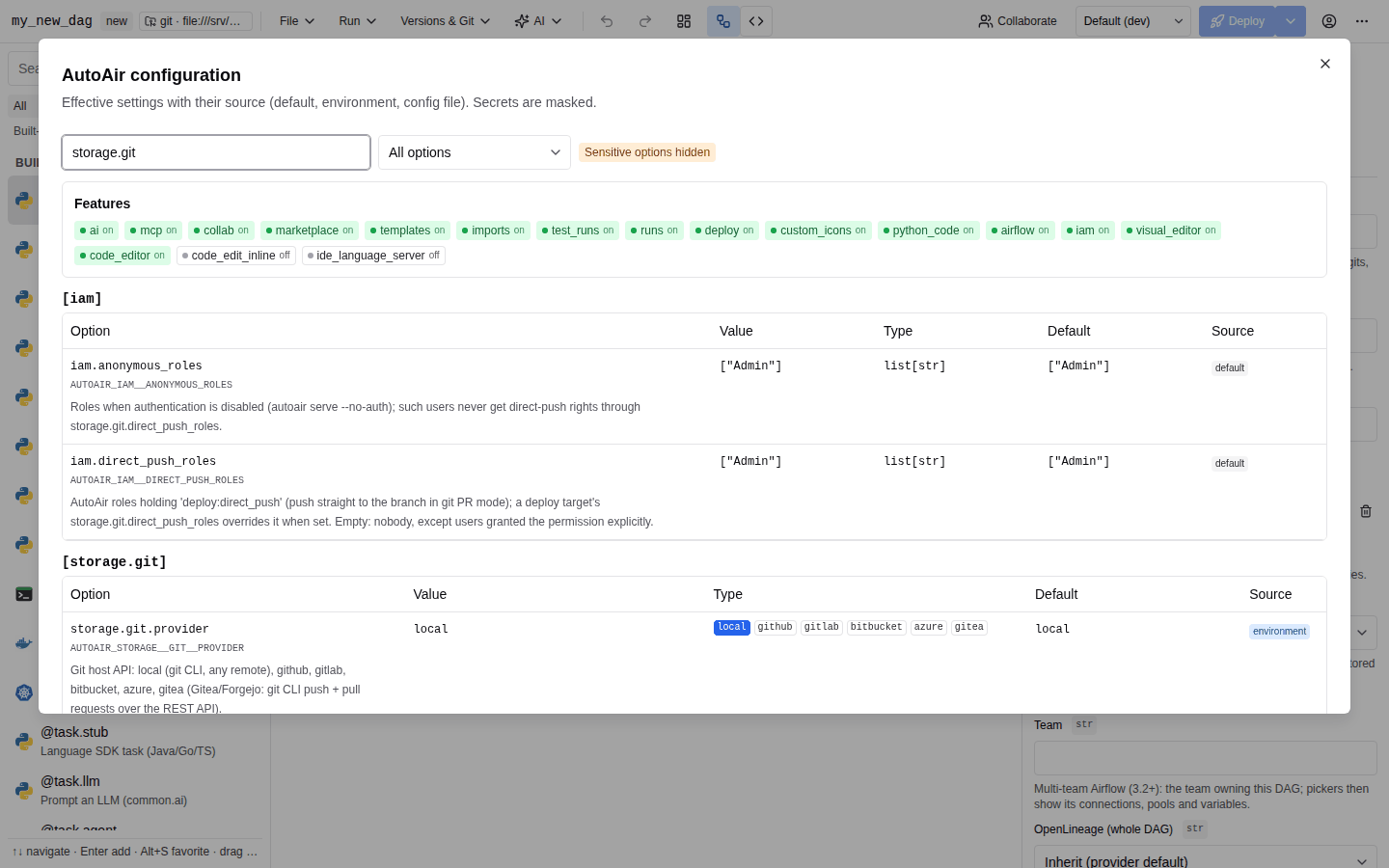
The page is read-only. It shows:
- a search box (Search options…) over key, environment variable and description, and a filter (All options / Changed from default);
- the configuration files in effect (Config files), and a Sensitive options hidden badge with
non-sensitive-only; - a Features summary: every
features.*flag as an on/off badge, with its environment variable in the tooltip; - one table per section of the configuration reference (top-level options under
[core]) with Option, Value, Type (choices of literal types as chips, the current one highlighted), Default and Source (default,environment,.env,argument,file,ui).
The admin panel has the same data in its Configuration tab. To change a value, change the environment or the configuration files and restart the process; nothing in the UI writes settings, except the deploy target dialog.
Secrets
What counts as a secret
A setting is treated as secret when any of these holds:
- its type is
SecretStr(for examplestorage.git.token,database.password,collab_secret,server.ssl_keyfile_password,ai.api_key,local.token); - the field is explicitly marked secret (for example
storage.storage_options, whose fsspec options usually carry credentials); - its name ends in
token,password,passwd,secret,api_key,private_key,credential(s)orheaders.
The last rule is a name heuristic, so a few non-sensitive switches are masked too: server.security_headers, server.proxy_headers, cors_allow_headers, cors_expose_headers and cors_allow_credentials show *** in /api/config and autoair config show. Use the configuration reference for their defaults.
Inside free-form maps (team_storage, storage.storage_options, outbound.clients, headers), keys that look like credentials are masked one by one: keys ending in key, secret, token, password, passwd, pwd, credential, credentials, sas, sas_token, account_key, connection_string, client_secret, private_key, authorization, auth, session_token, security_token, cookie or signature, and keys containing access_key, secret, password, credential, token, connection_string or private_key (case-insensitive). User information in URLs is masked as well: postgresql://autoair:pw@db/autoair is shown as postgresql://autoair:***@db/autoair.
Recommendations
- Keep credentials in environment variables or secret mounts, not in configuration files that DAG code or other users can read.
- Prefer settings that keep the secret out of URLs:
database.passwordinstead of a password indatabase.url;storage.git.github_private_key_fileinstead of the key inline. - For git deploys, prefer an Airflow connection (
storage.git.conn_id,storage.git.forced_conn_id, or per-user credentials) overstorage.git.token: AutoAir then never holds the token in its own settings. See Deploy. - With several replicas, set the keys that would otherwise be generated per host:
collab_secretandai.user_llm.encryption_key(see Scaling).
Secrets and DAG code
Processes that run DAG code (import checks, Python DAG imports, test runs) do not inherit AutoAir's secrets. AutoAir removes from their environment every AUTOAIR_* variable whose name matches sandbox.secret_env_pattern (TOKEN|SECRET|PASSWORD|PASSWD|API_KEY|PRIVATE_KEY|CREDENTIAL|EXTRA_HEADERS) and the variables in sandbox.scrub_env (ANTHROPIC_API_KEY, OPENAI_API_KEY, GEMINI_API_KEY, GOOGLE_API_KEY). Airflow's own configuration is passed through. Extend the lists with:
AUTOAIR_SANDBOX__SCRUB_ENV_EXTRA='["AWS_SECRET_ACCESS_KEY","VAULT_TOKEN"]'   # any variable
AUTOAIR_SANDBOX__SECRET_ENV_PATTERNS_EXTRA='["^AUTOAIR_ACME_"]'             # regexes over AUTOAIR_* names
Settings by area
Settings grouped by what they control. Each area links to the page that explains it in depth; exact types and defaults are in the reference.
Core
| Variable | Default | Description |
|---|---|---|
AUTOAIR_MODE | standalone (plugin inside Airflow, local for autoair local) | Deployment mode; set by the entry point |
AUTOAIR_DAGS_FOLDER | Airflow [core] dags_folder, else ./dags | Base folder for the local deploy target |
AUTOAIR_SUBFOLDER | autoair | Sub-folder for generated DAGs; AutoAir's state folder is <dags_folder>/<subfolder>/.autoair/ |
AUTOAIR_AIRFLOW_URL | Airflow [api] base_url, else http://localhost:8080 | Airflow REST API for pickers, status, runs and token checks |
AUTOAIR_AIRFLOW_SECRETS_BACKEND | false | Connections/variables come from a secrets backend the REST API cannot list; hides the pickers' "not found" hint |
AUTOAIR_IMPORT_CHECK_ON_DEPLOY | true | Import the DAG with a DagBag (warm worker pool) before writing |
AUTOAIR_TARGET_AIRFLOW_VERSION | installed version | Validate features against another Airflow version (for example 3.1.0) |
AUTOAIR_CORS_ORIGINS | [] | Standalone CORS; see TLS and HTTP headers |
Feature flags
AUTOAIR_FEATURES__<NAME>=false switches a feature off: its API routes answer 404, the matching CLI commands exit with code 2, and /api/meta reports the flag so the UI hides it. Every flag and its UI impact is described in Feature flags.
Storage and deploy target
| Variable | Description |
|---|---|
AUTOAIR_STORAGE__MODE | local (default), object or git |
AUTOAIR_STORAGE__LOCAL_PATH | Override the local folder (default dags_folder/subfolder) |
AUTOAIR_STORAGE__OBJECT_URL | fsspec URL of an S3/GCS bundle prefix, for example s3://bucket/dags/autoair/ |
AUTOAIR_STORAGE__STORAGE_OPTIONS | JSON fsspec options (secret) |
AUTOAIR_STORAGE__GIT__PROVIDER | local (git CLI, any remote), github, gitlab, bitbucket, azure, gitea (Gitea or Forgejo: git CLI push, pull requests over the REST API) |
AUTOAIR_STORAGE__GIT__REPO | owner/name (GitHub), project id or path (GitLab), workspace/repo (Bitbucket Cloud), organization/project/repository (Azure DevOps), remote URL (local, gitea) |
AUTOAIR_STORAGE__GIT__API_URL | REST API base URL for GitHub Enterprise, self-hosted GitLab, Azure DevOps Server; gitea: defaults to <scheme>://<host>/api/v1 of an HTTP(S) remote, required for SSH remotes |
AUTOAIR_STORAGE__GIT__USERNAME | Bitbucket app-password user (omit for access tokens) |
AUTOAIR_STORAGE__GIT__AZURE_BEARER | Azure DevOps: the token is an Entra ID bearer token instead of a PAT |
AUTOAIR_STORAGE__GIT__BASE_BRANCH | Branch Airflow's GitDagBundle tracks (default: the bundle ref, else main) |
AUTOAIR_STORAGE__GIT__SUBDIR | Folder inside the repository |
AUTOAIR_STORAGE__GIT__MODE | pr (default: a branch and pull request per DAG) or push (direct commit) |
AUTOAIR_STORAGE__GIT__TOKEN | PAT or project token (secret) |
AUTOAIR_STORAGE__GIT__GITHUB_APP_ID, AUTOAIR_STORAGE__GIT__GITHUB_INSTALLATION_ID, AUTOAIR_STORAGE__GIT__GITHUB_PRIVATE_KEY, AUTOAIR_STORAGE__GIT__GITHUB_PRIVATE_KEY_FILE | GitHub App authentication (recommended for GitHub) |
AUTOAIR_STORAGE__GIT__CONN_ID | Airflow git connection holding the credentials |
AUTOAIR_STORAGE__GIT__CREDENTIALS_TTL | Seconds credentials read from an Airflow connection are reused before the connection is read again (60); re-read at once and the operation retried after an authentication failure, so a rotated token needs no restart; 0 reads on every operation |
AUTOAIR_STORAGE__GIT__USE_AIRFLOW_BUNDLE, AUTOAIR_STORAGE__GIT__BUNDLE_NAME | Read repo, branch, subdir and connection from Airflow's dag_bundle_config_list |
AUTOAIR_STORAGE__GIT__ENVIRONMENTS | JSON map environment to branch for promotion, for example {"dev":"dev","prod":"main"} |
AUTOAIR_STORAGE__GIT__DIRECT_PUSH_ROLES | mode=pr: roles that may push straight to the branch; enforced by IAM (see IAM) |
AUTOAIR_STORAGE__GIT__BRANCH_PREFIX, AUTOAIR_STORAGE__GIT__BRANCH_TEMPLATE | Pending-change branch, default {branch_prefix}{environment_path}{dag_id} with prefix autoair/ |
AUTOAIR_STORAGE__GIT__PROMOTE_BRANCH_TEMPLATE | Promotion branch, default {branch_prefix}promote/{from_env}-to-{to_env}/{dag_id} |
AUTOAIR_STORAGE__GIT__COMMIT_MESSAGE_TEMPLATE, AUTOAIR_STORAGE__GIT__DELETE_MESSAGE_TEMPLATE, AUTOAIR_STORAGE__GIT__PROMOTE_MESSAGE_TEMPLATE | Commit messages ({dag_id}, {environment}, {author}, {from_env}, {to_env} and the context placeholders) |
AUTOAIR_STORAGE__GIT__PR_TITLE_TEMPLATE, AUTOAIR_STORAGE__GIT__PR_BODY_TEMPLATE | Pull request title and body ({message} is the commit message) |
AUTOAIR_STORAGE__GIT__PR_LABELS, AUTOAIR_STORAGE__GIT__PR_REVIEWERS, AUTOAIR_STORAGE__GIT__PR_DRAFT | Labels; reviewers (GitHub logins or org/team, GitLab usernames, Bitbucket account UUIDs, Azure identity ids, Gitea usernames); draft PRs (Gitea: a WIP: title prefix) |
AUTOAIR_STORAGE__GIT__DELETE_BRANCH_AFTER_MERGE | Ask GitLab/Bitbucket/Azure DevOps to delete the source branch on merge (true; a repository setting on GitHub) |
AUTOAIR_STORAGE__GIT__COMMITTER_NAME, AUTOAIR_STORAGE__GIT__COMMITTER_EMAIL | provider=local and gitea: committer identity |
AUTOAIR_STORAGE__GIT__SSH_KEY_FILE, AUTOAIR_STORAGE__GIT__CACHE_DIR, AUTOAIR_STORAGE__GIT__FETCH_INTERVAL | provider=local and gitea: SSH key, clone cache, seconds between fetches (5) |
AUTOAIR_STORAGE__GIT__TIMEOUT, AUTOAIR_STORAGE__GIT__COMMAND_TIMEOUT, AUTOAIR_STORAGE__GIT__MAX_ATTEMPTS, AUTOAIR_STORAGE__GIT__READ_CACHE_SIZE | REST timeout (30 s), git CLI timeout (300 s), retries when the branch moves (3), cached file reads (512) |
AUTOAIR_STORAGE__FILE_MODE, AUTOAIR_STORAGE__DIR_MODE | mode=local: permissions of written files (0644) and created folders (umask) |
AUTOAIR_STORAGE__TEMP_DIR | mode=local: folder of the temporary file of atomic writes; must be on the same file system |
AUTOAIR_STORAGE__HISTORY_LIMIT | Saved versions kept per DAG (100) |
Example: conventional commits, draft PRs reviewed by a team, admins push directly.
AUTOAIR_STORAGE__GIT__COMMIT_MESSAGE_TEMPLATE='chore(dags): update {dag_id}'
AUTOAIR_STORAGE__GIT__PR_DRAFT=true AUTOAIR_STORAGE__GIT__PR_REVIEWERS='["acme/data-platform"]'
AUTOAIR_STORAGE__GIT__DIRECT_PUSH_ROLES='["Admin"]'
Deploy target policy
Administrators decide which kinds of targets exist and which credentials git deploys use. The deploy-target dialog and PUT /api/deploy-target cannot change these settings.
| Variable | Description |
|---|---|
AUTOAIR_STORAGE__ALLOWED_TARGETS | Target kinds offered and accepted, for example ["git"] or ["local"] (default all three). storage.mode must be one of them; a UI-chosen target of another kind is refused (400) or ignored at start-up |
AUTOAIR_STORAGE__GIT__FORCED_CONN_ID | Every git deploy uses this Airflow connection (overrides conn_id and the bundle's connection); shown read-only in the dialog |
AUTOAIR_STORAGE__GIT__CREDENTIALS_MODE | shared (default: one service connection or token) or per_user (each user's own Airflow connection) |
AUTOAIR_STORAGE__GIT__USER_CONN_ID_TEMPLATE | per_user: the user's connection id, default git_{username} (username lower-cased, characters outside [A-Za-z0-9_.-] become _) |
AUTOAIR_STORAGE__GIT__USER_CONN_ID_PATTERN | per_user: regex of connection ids a user may pick in the deploy dialog instead, for example git_.* |
AUTOAIR_STORAGE__GIT__USER_CREDENTIALS_FALLBACK | per_user: use the shared credentials when the user has no readable connection (default false: refuse) |
AUTOAIR_STORAGE__GIT__COMMIT_AUTHOR | auto (default: the user with per-user credentials, else the service), service (the token's identity authors; the user is in the trailers and Co-authored-by), user (Name <email> of the user). GitHub's API always commits as the token owner |
Per-user credentials. With credentials_mode=per_user, every commit and pull request uses the deploying user's own Airflow connection. AutoAir first asks Airflow for the connection with the user's token (GET /api/v2/connections/{id}), so Airflow's RBAC decides whether the user may use it. Only then is the secret resolved server-side through Airflow's connections/secrets backend (Airflow's REST API never returns passwords), used for that one write and dropped; AutoAir stores no credentials. This needs AutoAir to see Airflow's connections: plugin mode, or standalone with Airflow installed and its metadata database or secrets backend configured. Reads (listing, history, pending pull requests) keep the shared credentials; without any, public repositories are read anonymously. A user without a readable connection gets a 403 (or the shared credentials with user_credentials_fallback). GET /api/deploy-target/git-credentials tells the UI which connection the caller's deploys use.
Deploy governance
Every commit and pull request AutoAir creates records who made it and what was checked:
-
the user's message from the deploy dialog (first line = subject), or
commit_message_template; -
a mandatory context block, always appended; users cannot remove it:
--- AutoAir deploy context ---Action: deployDAG: etl_daily (environment prod)User: alice (Alice Smith <alice@acme.io>)Spec version: 1a2b3c4d5e6f -> 9f8e7d6c5b4aValidation: passed (0 errors, 2 warnings, 0 infos, import check ok)Approved by: bobTarget: github:acme/dags@main (pr)AutoAir: 0.9.0Link: https://autoair.acme.io/ui/?dag=etl_daily -
git trailers as the last paragraph:
X-AutoAir-User,X-AutoAir-User-Name,X-AutoAir-Dag,X-AutoAir-Environment,X-AutoAir-Spec-Etag,X-AutoAir-Base-Etag,X-AutoAir-Validation,X-AutoAir-Version,Approved-by(one per approver), andCo-authored-bywhen the service identity authors the commit.git log --format='%(trailers:key=X-AutoAir-User)'lists who deployed what.
The pull request description is pr_body_template ({message}, {description} = the PR description typed in the deploy dialog), with the context block appended unless the template places {context} itself. All commit and PR templates accept the context placeholders {user}, {user_name}, {user_email}, {autoair_version}, {etag_before}, {etag_after}, {validation}, {approvals}, {link}, {target}, {description}, {context}. User-supplied values are reduced to one line, so nobody can forge trailers. The deploy dialog shows a live preview (POST /api/specs/{dag_id}/deploy-preview). Local-folder and object-storage targets store the same message with each version. The link needs AUTOAIR_SERVER__PUBLIC_URL. Deploys, pull requests, direct pushes, deletes, promotions, proposals and reviews are audited with the same context (see Audit).
Policy
The flat switches AUTOAIR_ALLOW_PYTHON_CODE, AUTOAIR_ALLOW_PRIVILEGED_OPERATORS, AUTOAIR_REQUIRE_OWNER, AUTOAIR_REQUIRE_DESCRIPTION, AUTOAIR_MIN_RETRIES, AUTOAIR_REQUIRED_TAGS, AUTOAIR_FORBIDDEN_OPERATORS, AUTOAIR_MAX_TASKS, AUTOAIR_DAG_ID_PREFIX, AUTOAIR_PYTHON_REF_ALLOW and the palette lists AUTOAIR_OPERATOR_ALLOW / AUTOAIR_OPERATOR_DENY, plus the pattern rules of the policy section (privileged operators, dag_id and task_id patterns, secret detection, extra Jinja names), are validation rules. On top of them, policy.rules holds declarative rules (match and check, with a severity) and policy.opa_url, policy.opa_timeout, policy.opa_fail_mode, policy.opa_token, policy.opa_headers and policy.opa_cache_seconds connect an Open Policy Agent. Their effect and where they are enforced are described in Policy.
Catalog and performance
| Variable | Description |
|---|---|
AUTOAIR_CATALOG_FILE | Precomputed catalog (autoair catalog build) for fast start-up |
AUTOAIR_CATALOG_STRATEGY | static (AST, no imports; default) or import |
AUTOAIR_CACHE_DIR | Disk cache for the catalog (default $XDG_CACHE_HOME/autoair) |
AUTOAIR_EXTRA_OPERATOR_MODULES | In-house operator modules to add to the palette |
The discovery section | Discovery filters (all listed under Operators); part of the cache key |
AUTOAIR_CATALOG_FALLBACK_TIMEOUT | Seconds a build may spend introspecting classes in a subprocess (300) |
AUTOAIR_DAGBAG_POOL | Warm DagBag validation workers (true) |
AUTOAIR_DAGBAG_POOL_SIZE | Number of warm workers (2) |
AUTOAIR_DAGBAG_POOL_MAX_TASKS | Checks per worker before it is recycled (50) |
The catalog cache is keyed by the installed Airflow distributions, the AutoAir version, the strategy, custom operator files, the discovery filters, a hash of AutoAir's catalog-building code and a hash of the cache layout. Upgrading or patching AutoAir therefore never serves a stale cache or a stale AUTOAIR_CATALOG_FILE; there is no format number to bump and no cache to clear by hand.
Timeouts and limits
| Variable | Default | Description |
|---|---|---|
AUTOAIR_AIRFLOW_TIMEOUT | 15 | Seconds per call to Airflow's REST API |
AUTOAIR_AUTH_TIMEOUT | 10 | Standalone: seconds for the bearer-token check against Airflow |
AUTOAIR_AUTH_CACHE_TTL | 60 | Standalone: seconds a verified token is trusted (0 checks every request) |
AUTOAIR_IMPORT_CHECK_TIMEOUT | 60 | Seconds per DagBag import check (validate, deploy) |
AUTOAIR_PYTHON_IMPORT_TIMEOUT | 90 | Seconds to import a hand-written Python DAG |
AUTOAIR_MARKETPLACE_TIMEOUT | 15 | Seconds per marketplace index or payload download |
AUTOAIR_MARKETPLACE_CACHE_TTL | 300 | Seconds a fetched marketplace index is reused |
AUTOAIR_MARKETPLACE_MAX_BYTES | 5242880 | Largest marketplace index or payload accepted |
AUTOAIR_COLLAB_TICKET_TTL | 600 | Seconds a live-editing ticket is valid |
AUTOAIR_COLLAB_MAX_ROOMS | 500 | Live-editing rooms per process |
AUTOAIR_DAGBAG_POOL_START_TIMEOUT | 120 | Seconds a DagBag worker may take to start |
AUTOAIR_RUNNER__DEFAULT_TASK_TIMEOUT / AUTOAIR_RUNNER__DEFAULT_DAG_TIMEOUT / AUTOAIR_RUNNER__MAX_TIMEOUT | 120 / 300 / 600 | Test runs: defaults and the largest timeout a request may ask for |
AUTOAIR_RUNNER__MAX_LOG_CHARS / AUTOAIR_RUNNER__MAX_VALUE_CHARS | 64000 / 4000 | Test runs: log and return-value size returned |
AUTOAIR_INTERCHANGE__MAX_SOURCE_CHARS / AUTOAIR_INTERCHANGE__YAML_MAX_NODES | 2000000 / 200000 | Largest import source; YAML alias-expansion guard |
AUTOAIR_EDITOR__MAX_SOURCE_CHARS, AUTOAIR_EDITOR__MAX_COMPLETIONS, AUTOAIR_EDITOR__MAX_DOC_CHARS | 200000, 100, 4000 | Editor services |
AUTOAIR_EDITOR__SHELLCHECK_TIMEOUT, AUTOAIR_EDITOR__SHELLCHECK_EXCLUDE, AUTOAIR_EDITOR__SHELLCHECK_EXCLUDE_EXTRA, AUTOAIR_EDITOR__SHELLCHECK_IN_VALIDATION | 5, SC1091,SC2034,SC2154, true | ShellCheck |
AUTOAIR_EDITOR__PYTHON_LINT_SELECT, AUTOAIR_EDITOR__PYTHON_LINT_SELECT_EXTRA, AUTOAIR_EDITOR__PYTHON_LINT_IGNORE, AUTOAIR_EDITOR__PYTHON_LINT_IGNORE_EXTRA, AUTOAIR_EDITOR__PYTHON_LINT_TIMEOUT | ruff F,E9,B006,B008,B012,B018,PLE / F401, 15 | Lint of task code |
AUTOAIR_EDITOR__VALIDATE_TIMEOUT, AUTOAIR_EDITOR__VALIDATE_COMMANDS | 15, {} | External checkers of code fields (bash -n, sh -n, tsc, esbuild, gofmt, javac) |
AUTOAIR_CODEGEN__LINE_LENGTH / AUTOAIR_CODEGEN__FORMAT_TIMEOUT | 100 / 30 | Generated DAG files |
AUTOAIR_ICONS__MAX_UPLOAD_BYTES / AUTOAIR_ICONS__MAX_SIDE / AUTOAIR_ICONS__MAX_PIXELS | 524288 / 128 / 16777216 | Custom icons |
AUTOAIR_LSP__PYTHON_SERVER | basedpyright | Python language server behind features.ide_language_server: basedpyright or pylsp |
AUTOAIR_LSP__BASEDPYRIGHT_COMMAND, AUTOAIR_LSP__PYLSP_COMMAND, AUTOAIR_LSP__BASH_COMMAND | ["basedpyright-langserver", "--stdio"], ["pylsp"], ["bash-language-server", "start"] | Commands starting the language servers |
AUTOAIR_LSP__MAX_SESSIONS, AUTOAIR_LSP__MAX_SESSIONS_PER_USER | 16, 4 | Language-server processes alive at once, and per user |
AUTOAIR_LSP__IDLE_TIMEOUT, AUTOAIR_LSP__START_TIMEOUT | 600, 30 | Seconds without a message before a session closes; seconds a server may take to start |
AUTOAIR_LSP__MEMORY_LIMIT_MB, AUTOAIR_LSP__CPU_LIMIT_SECONDS, AUTOAIR_LSP__MAX_MESSAGE_BYTES | 2048, 3600, 8388608 | Process limits and the largest JSON-RPC message |
AUTOAIR_SERVER__HOST / AUTOAIR_SERVER__PORT | 127.0.0.1 / 8765 | autoair serve bind address |
AUTOAIR_SERVER__GZIP_MIN_SIZE / AUTOAIR_SERVER__GZIP_LEVEL | 2048 / 6 | Response compression |
AUTOAIR_SERVER__AIRFLOW_FETCH_CONCURRENCY / AUTOAIR_SERVER__AIRFLOW_PAGE_SIZE | 8 / 1000 | Airflow API client |
AUTOAIR_SERVER__OTEL_EXCLUDED_URLS | ["health","ready","metrics"] | Not traced |
AUTOAIR_PLUGIN__NAV_NAME, AUTOAIR_PLUGIN__NAV_CATEGORY, AUTOAIR_PLUGIN__DAG_TAB_NAME, AUTOAIR_PLUGIN__DAG_TAB, AUTOAIR_PLUGIN__DAG_TAB_TAGS | DAG Builder, browse, AutoAir, true, [] | Airflow UI entries (plugin mode); the tags limit the DAG tab to tagged DAGs on Airflow 3.4+ |
Security notes
- Routes that execute DAG code on the AutoAir host (
/validate?import_check=true, Python DAG import, the task runner) require thecode:executeorrun:testpermission; see IAM. Reading, static validation and code generation only needbuilder:use. - Processes running DAG code do not inherit AutoAir's secrets (see Secrets and DAG code).
- The schedule preview (
/airflow/next-runs) evaluates only the schedule, dates and timezone; params, tasks, callbacks and asset extras are never executed in the API process. AUTOAIR_CORS_ORIGINS=["*"]never sendsAccess-Control-Allow-Credentials; list explicit origins to allow credentialed cross-origin calls.
Environments, teams and state
AUTOAIR_ENVIRONMENTS, AUTOAIR_DEFAULT_ENVIRONMENT and AUTOAIR_TEAM define environments and the deployment's team. AUTOAIR_TEAM_STORAGE is a JSON map team to storage settings, for example {"team_a": {"mode": "git", "git": {"provider": "github", "repo": "acme/team-a-dags"}}}: DAGs whose team is set are deployed there, and connection, pool and variable pickers offer only global and team objects. AUTOAIR_TEAM_DAG_ID_PREFIX requires <team>_ dag ids. AUTOAIR_TEMPLATES_URL, AUTOAIR_AUDIT_URL and AUTOAIR_ICONS_URL are fsspec URLs for state that defaults to <dags_folder>/<subfolder>/.autoair/templates, <dags_folder>/<subfolder>/.autoair/audit and <dags_folder>/<subfolder>/.autoair/icons. Loader-mode DAGs apply the overlay named by AUTOAIR_ENVIRONMENT on the dag-processor and workers. See Environments and Multi-team.
Database (state store)
AUTOAIR_DATABASE__BACKEND selects where AutoAir keeps its own state (templates, audit trail, AI memory and audit, reviews and proposals, the UI-chosen deploy target, icons, collaboration snapshots): file (default), sqlite or postgresql. Backends, URLs, TLS, pooling and autoair db migrations are in Database; multi-replica behaviour is in Scaling.
Server, TLS and HTTP security
autoair serve and autoair local read the server section: public URL, workers, TLS and mutual TLS, trusted proxies, security headers and CSP, HSTS, cookie attributes, the body-size limit, metrics and readiness checks. The most common ones are also CLI options (--workers, --ssl-certfile, --ssl-keyfile, --ssl-ca-certs, --ssl-cert-reqs, --forwarded-allow-ips). See TLS and HTTP headers. Sign-in with the Airflow UI session, CSRF and cookie scope are in SSO and sessions.
Outgoing connections: CA bundle, client certificates, proxies
One helper configures every outgoing client: the Airflow REST client and token checks, the sign-in proxy, git hosting APIs and the git CLI, marketplaces, AI providers (including the DNS-pinned transports), the reranker, online research, external MCP servers and the Open Policy Agent.
| Variable | Description |
|---|---|
AUTOAIR_OUTBOUND__CA_BUNDLE | PEM file or hashed folder used instead of the default trust store (corporate root CA) |
AUTOAIR_OUTBOUND__CLIENT_CERT, AUTOAIR_OUTBOUND__CLIENT_KEY, AUTOAIR_OUTBOUND__CLIENT_KEY_PASSWORD | Mutual TLS towards servers |
AUTOAIR_OUTBOUND__VERIFY | true; false disables verification and logs a warning per client (test setups only) |
AUTOAIR_OUTBOUND__HTTP_PROXY, AUTOAIR_OUTBOUND__HTTPS_PROXY, AUTOAIR_OUTBOUND__NO_PROXY | Proxies (explicit ones win over the environment); no_proxy entries are hosts, .domain suffixes, IPs or host:port |
AUTOAIR_OUTBOUND__TRUST_ENV | Also honour HTTP_PROXY, HTTPS_PROXY, NO_PROXY, SSL_CERT_FILE from the environment (true) |
AUTOAIR_OUTBOUND__CLIENTS | Per-client overrides, for example {"git": {"ca_bundle": "/etc/ssl/gitlab.pem"}, "ai": {"proxy": "http://egress:3128"}}; clients airflow, git, marketplace, ai, research, login, mcp, opa |
The git CLI (provider=local) gets the same settings as http.sslCAInfo/http.sslCAPath, http.sslVerify, http.sslCert/http.sslKey and http.proxy (through GIT_CONFIG_* variables, never on the command line) and NO_PROXY. AI research keeps its own ai.research.proxy when set.
Logging, rate limits and UI
| Variable | Description |
|---|---|
AUTOAIR_LOGGING__LEVEL, AUTOAIR_LOGGING__FORMAT, AUTOAIR_LOGGING__LEVELS | Root level (INFO), text or json, per-logger levels; see Observability |
AUTOAIR_LIMITS__RATE_LIMITS | Requests per user and window: {"validate": 240, "import": 60, "ai": 60, "test_runs": 30, "deploy": 60, "catalog_refresh": 6} (0 = unlimited); above it 429 with Retry-After |
AUTOAIR_LIMITS__ROLE_RATE_LIMITS | Per AutoAir role, for example {"Admin": {"ai": 0}, "Viewer": {"validate": 30}}; the most generous limit of the user's roles applies (0 wins) |
AUTOAIR_LIMITS__WINDOW_SECONDS, AUTOAIR_LIMITS__RATE_LIMITS_ENABLED, AUTOAIR_LIMITS__MAX_TRACKED_USERS | Window (60 s), switch, memory bound; counters are per process |
AUTOAIR_UI__TITLE, AUTOAIR_UI__LOGO_URL, AUTOAIR_UI__ACCENT_COLOR | Branding: title in the tab and on the sign-in page, logo, accent strip (hex or a Chakra palette name) |
AUTOAIR_UI__BANNER_TEXT, AUTOAIR_UI__BANNER_COLOR | A banner above the builder, for example PRODUCTION in red, or a maintenance notice |
AUTOAIR_UI__DEFAULT_LANGUAGE, AUTOAIR_UI__DEFAULT_TIMEZONE, AUTOAIR_UI__DATE_LOCALE | Defaults for users who never chose (language en/tr; IANA zone; BCP 47 locale) |
Session and token lifetimes: Airflow's [api_auth] jwt_expiration_time bounds sessions; AUTOAIR_AUTH_CACHE_TTL (verified tokens), AUTOAIR_COLLAB_TICKET_TTL, and AUTOAIR_SSO__REFRESH_MARGIN_SECONDS / AUTOAIR_SSO__SESSION_CHECK_SECONDS (UI) are AutoAir's own. See SSO and sessions.
Observability
AUTOAIR_OTEL_ENABLED=true (with pip install 'autoair[otel]') instruments the API with OpenTelemetry. Prometheus metrics are at /api/metrics unless AUTOAIR_SERVER__METRICS_ENABLED=false. See Observability. Audit records go to the sinks in audit.sinks (file, db, log, otel); see Audit.
AI & MCP
AI features (generate and edit, explain, write code, fix, review, leak scan, optimise, docs, ask, research) run on pydantic-ai with Anthropic, OpenAI and OpenAI-compatible endpoints (Azure OpenAI, vLLM, LM Studio, LiteLLM), Google Gemini / Vertex AI, Ollama, Bedrock, Groq, Mistral and Cohere. Install autoair[ai] plus the provider extra (ai-anthropic, ai-openai, ai-google, ai-ollama, ai-bedrock, ai-groq, ai-mistral, ai-cohere, ai-all); without it AI is off and the admin panel names the extra to install. All AI settings live in the ai section (AUTOAIR_AI__<FIELD>, AUTOAIR_AI__<SUBSECTION>__<FIELD>). Design and deployment are described in AI architecture, providers in AI providers, guardrails in Guardrails, the separate AI service in AI service and the MCP server in MCP.
features.ai=false hides AI entirely (only GET /api/ai/status answers, with enabled: false). ai.enabled=false keeps the rules-only features (leak scan, review, optimise, search) and answers 503 for LLM features. features.mcp=false unmounts /mcp.
Model (central)
| Variable | Default | Description |
|---|---|---|
AUTOAIR_AI__PROVIDER | inferred | anthropic, openai, gemini, ollama. Inferred from a provider: prefix in the model, else from the first key found (ANTHROPIC_API_KEY, OPENAI_API_KEY, GEMINI_API_KEY/GOOGLE_API_KEY) |
AUTOAIR_AI__MODEL | per provider | claude-sonnet-5-5 (Anthropic; also claude-opus-5-5, claude-haiku-5-5), gpt-4.1, gemini-2.5-pro, qwen3:14b. A provider: prefix also selects the provider (openai:gpt-4.1, ollama:llama3.1:8b) |
AUTOAIR_AI__MODELS | provider suggestions | JSON list of models users may pick per request |
AUTOAIR_AI__API_KEY | none | Key of the configured provider (secret, never logged). For Anthropic, AUTOAIR_AI__ANTHROPIC_API_KEY, AUTOAIR_ANTHROPIC_API_KEY and ANTHROPIC_API_KEY also work |
AUTOAIR_AI__BASE_URL | provider default | OpenAI-compatible base URL (http://vllm:8000/v1), Azure deployment URL, Ollama URL or a gateway |
AUTOAIR_AI__API_VERSION, AUTOAIR_AI__EXTRA_HEADERS, AUTOAIR_AI__EFFORT | none | Azure api-version; JSON gateway headers; Anthropic effort / OpenAI reasoning_effort |
AUTOAIR_AI__LLM_CONN_ID | none | Airflow connection with the provider credentials (wins over the variables above) |
AUTOAIR_AI__TIMEOUT_SECONDS / AUTOAIR_AI__MAX_RETRIES / AUTOAIR_AI__MAX_OUTPUT_TOKENS | 180 / 3 / 16000 | Per call; retries use jittered backoff and honour Retry-After |
AUTOAIR_AI__PRICING | {} | USD per million tokens per model (prefix match); enables usage.cost_usd and cost budgets |
AUTOAIR_AI__LLM_MODE | central | central, per_user (every user sets My AI model), both (the user's model when set) |
AUTOAIR_AI__USER_LLM__ALLOWED_PROVIDERS | ["anthropic", "openai", "gemini", "ollama"] | Providers users may choose |
AUTOAIR_AI__USER_LLM__ALLOWED_MODELS | ["*"] | Models users may choose (fnmatch) |
AUTOAIR_AI__USER_LLM__ALLOWED_BASE_URLS | [] | Base URL prefixes users may set (empty = provider defaults only) |
AUTOAIR_AI__USER_LLM__ALLOW_PRIVATE_NETWORKS | false | Allow user base URLs on private networks (SSRF) |
AUTOAIR_AI__USER_LLM__ALLOWED_CONN_IDS | [] | Airflow connection ids users may reference instead of a key (fnmatch; empty = not allowed) |
AUTOAIR_AI__USER_LLM__ENCRYPTION_KEY | key file in the state folder | Fernet key encrypting stored user API keys (set it for several replicas) |
AUTOAIR_AI__USER_LLM__STORE_URL | <state>/ai-users | Where per-user model settings are stored |
Agent, streaming, guardrails, audit
| Variable | Default | Description |
|---|---|---|
AUTOAIR_AI__AGENT__MAX_STEPS / AUTOAIR_AI__AGENT__TOKEN_BUDGET / AUTOAIR_AI__AGENT__COST_BUDGET_USD | 8 / 250000 / none | Per agent run; the last step withdraws the tools so the model answers |
AUTOAIR_AI__AGENT__TIMEOUT_SECONDS / AUTOAIR_AI__AGENT__TOOL_TIMEOUT_SECONDS | 300 / 90 | Wall clock per run / per tool call |
AUTOAIR_AI__STREAM_HEARTBEAT_SECONDS | 15 | SSE keep-alive interval |
AUTOAIR_AI__GUARDRAILS__REDACT_SECRETS / AUTOAIR_AI__GUARDRAILS__REDACT_PATTERNS | true / [] | Secret redaction before text leaves AutoAir (plus site regexes) |
AUTOAIR_AI__GUARDRAILS__PII_MASKING / AUTOAIR_AI__GUARDRAILS__PII_ENTITIES | false | Mask e-mails, phones, cards, IBANs, SSNs (IPv4 optional) |
AUTOAIR_AI__GUARDRAILS__PROMPT_INJECTION | flag | off, flag, block for retrieved content and tool outputs (AUTOAIR_AI__GUARDRAILS__INJECTION_PATTERNS_EXTRA: more regexes) |
AUTOAIR_AI__GUARDRAILS__TOOL_ALLOWLIST | per role | JSON {"viewer": ["search_*", "get_operator", "validate_spec", "lint_spec", "render_code", "get_saved_spec", "list_dag_runs", "list_task_instances", "run_statistics", "read_source", "list_installed_packages", "get_package_info", "fetch_doc", "get_current_spec", "propose_spec_change", "write_code", "list_conventions", "remember"], "editor": ["*"], "admin": ["*"]} (fnmatch over tool names) |
AUTOAIR_AI__GUARDRAILS__CHECK_GENERATED_CODE | true | Writers must pass validation, ruff and ShellCheck before code is presented as valid |
AUTOAIR_AI__GUARDRAILS__EXTERNAL | [] | llm_guard, nemo:<dir>, guardrails_ai, or module:factory (autoair[ai-guardrails]) |
AUTOAIR_AI__AUDIT__ENABLED / AUTOAIR_AI__AUDIT__URL / AUTOAIR_AI__AUDIT__INCLUDE_PROMPTS | true / <state>/ai-audit / false | Audit log of AI calls (GET /api/ai/audit, ai:admin); see Audit |
AUTOAIR_AI__AUDIT__RETENTION_DAYS / AUTOAIR_AI__AUDIT__MAX_TOTAL_MB | 90 / 1024 | AI audit retention by age and by size (0 = no limit) |
AUTOAIR_AI__PROMPTS__OVERRIDE_DIR | none | <NAME>.md replaces the system prompt NAME (GET /api/ai/prompts lists them) |
AUTOAIR_AI__WRITERS__MAX_REPAIRS | 2 | Validate-and-repair rounds of the code writers |
Retrieval, research, knowledge base
| Variable | Default | Description |
|---|---|---|
AUTOAIR_AI__EMBEDDING__PROVIDER / AUTOAIR_AI__EMBEDDING__MODEL / AUTOAIR_AI__EMBEDDING__BASE_URL | none | openai, gemini, ollama: hybrid retrieval (BM25 plus embeddings fused with RRF; vectors cached in <cache>/ai-embeddings.sqlite3) |
AUTOAIR_AI__RETRIEVAL__TOP_K / AUTOAIR_AI__RETRIEVAL__CANDIDATE_POOL / AUTOAIR_AI__RETRIEVAL__RRF_K | 8 / 40 / 60 | Ranking |
AUTOAIR_AI__RETRIEVAL__CHUNK_SIZE / AUTOAIR_AI__RETRIEVAL__CHUNK_OVERLAP | 1200 / 150 | Code-aware chunking |
AUTOAIR_AI__RETRIEVAL__RERANKER | none | cross_encoder (autoair[ai-rerank]), llm, cohere, voyage, jina (plus AUTOAIR_AI__RETRIEVAL__RERANK_MODEL, AUTOAIR_AI__RETRIEVAL__RERANK_API_KEY) |
AUTOAIR_AI__RETRIEVAL__QUERY_EXPANSION / AUTOAIR_AI__RETRIEVAL__LLM_QUERY_REWRITE / AUTOAIR_AI__RETRIEVAL__SYNONYMS | true / false / {} | Vocabulary expansion (plus site terms); LLM rewrites for research |
AUTOAIR_AI__ASSIST__MAX_LOG_CHARS | 12000 | Tail of a failed task's log sent to fix |
AUTOAIR_AI__ASSIST__MAX_CODE_CHARS | 40000 | Code sent to explain-code (truncated) |
AUTOAIR_AI__ASSIST__FINDINGS_MAX_TOKENS | 12000 | max_tokens of review / leak / optimise / fix calls |
AUTOAIR_AI__ASSIST__EXPLAIN_MAX_TOKENS / AUTOAIR_AI__ASSIST__EXPLAIN_CODE_MAX_TOKENS / AUTOAIR_AI__ASSIST__TASK_CODE_MAX_TOKENS | 6000 / 3000 / 8000 | max_tokens of explain-DAG, explain-code and task-code / writer calls |
AUTOAIR_AI__ASSIST__FIX_ROUNDS | 2 | Patch-and-revalidate rounds of fix |
AUTOAIR_AI__ASSIST__DEFAULT_TASK_TIMEOUT_SECONDS / AUTOAIR_AI__ASSIST__DEFAULT_SENSOR_TIMEOUT_SECONDS | 3600 / 21600 | Timeouts the rules suggest for tasks and sensors |
AUTOAIR_AI__ASSIST__MEMORY_MAX_ITEMS | 2000 | Conventions/preferences the AI memory keeps |
AUTOAIR_AI__RESEARCH__ONLINE | false | Air-gapped by default; true allows fetch_doc and PyPI on AUTOAIR_AI__RESEARCH__ALLOWED_DOMAINS |
AUTOAIR_AI__RESEARCH__ALLOWED_DOMAINS | airflow.apache.org, pypi.org, raw.githubusercontent.com | Online allow-list (sub-domains included) |
AUTOAIR_AI__RESEARCH__PROXY / AUTOAIR_AI__RESEARCH__RATE_LIMIT_PER_MINUTE / AUTOAIR_AI__RESEARCH__MAX_BYTES / AUTOAIR_AI__RESEARCH__CACHE_TTL_SECONDS | none / 30 / 2 MiB / 1 day | Online fetch limits |
AUTOAIR_AI__RESEARCH__PACKAGE_PATTERNS / AUTOAIR_AI__RESEARCH__EXTRA_SOURCE_DIRS | apache-airflow*, airflow* / [] | What the installed-environment index covers; extra folders read_source may read |
AUTOAIR_AI__KNOWLEDGE__DISABLED / AUTOAIR_AI__KNOWLEDGE__EXTRA_DIRS / AUTOAIR_AI__KNOWLEDGE__STORE_URL | [] / [] / <state>/ai-knowledge | Built-in docs to switch off; site folders (same file name replaces a built-in doc); where UI overrides live |
AUTOAIR_AI__MEMORY_URL | <state>/ai-memory | Conventions and preferences memory |
Assistants, troubleshooting, external MCP servers, rules (see Assistants and AI troubleshooting)
| Variable | Default | Description |
|---|---|---|
AUTOAIR_AI__ASSISTANTS__DEVELOPER__ENABLED / AUTOAIR_AI__ASSISTANTS__ADMIN__ENABLED | true | Assistant switched on |
AUTOAIR_AI__ASSISTANTS__DEVELOPER__TOOLS / AUTOAIR_AI__ASSISTANTS__ADMIN__TOOLS | ["*"] | Tool allow-list (fnmatch) |
AUTOAIR_AI__ASSISTANTS__DEVELOPER__MAX_STEPS / AUTOAIR_AI__ASSISTANTS__ADMIN__MAX_STEPS | 10 / 12 | Model turns per chat turn |
AUTOAIR_AI__ASSISTANTS__DEVELOPER__MEMORY / AUTOAIR_AI__ASSISTANTS__ADMIN__MEMORY | true | Use and offer to store memories in the assistant's scope |
AUTOAIR_AI__ASSISTANTS__DEVELOPER__ALLOW_EXTERNAL_MCP / AUTOAIR_AI__ASSISTANTS__ADMIN__ALLOW_EXTERNAL_MCP | true | Attach the external MCP servers scoped to the assistant |
AUTOAIR_AI__ASSISTANTS__COMPACTION_TRIGGER_CHARS / AUTOAIR_AI__ASSISTANTS__COMPACTION_KEEP_MESSAGES | 40000 / 6 | Summarise older turns of long threads |
AUTOAIR_AI__ASSISTANTS__MAX_THREADS_PER_USER / AUTOAIR_AI__ASSISTANTS__MAX_MESSAGES_PER_THREAD / AUTOAIR_AI__ASSISTANTS__STORE_URL | 200 / 400 / <state>/ai-threads | Thread retention and location (SQL rows with a database backend) |
AUTOAIR_AI__TROUBLESHOOT__ENABLED | true | "Analyze with AI" on runs and task instances |
AUTOAIR_AI__TROUBLESHOOT__RESOURCES__CONNECTIONS, AUTOAIR_AI__TROUBLESHOOT__RESOURCES__VARIABLES, AUTOAIR_AI__TROUBLESHOOT__RESOURCES__POOLS, AUTOAIR_AI__TROUBLESHOOT__RESOURCES__XCOM_KEYS, AUTOAIR_AI__TROUBLESHOOT__RESOURCES__OTHER_RUNS, AUTOAIR_AI__TROUBLESHOOT__RESOURCES__IMPORT_ERRORS (true); AUTOAIR_AI__TROUBLESHOOT__RESOURCES__XCOM_VALUES, AUTOAIR_AI__TROUBLESHOOT__RESOURCES__AIRFLOW_CONFIG (false) | as listed | What the agent may read at most (users can only narrow it) |
AUTOAIR_AI__TROUBLESHOOT__FILESYSTEM__ROOTS / AUTOAIR_AI__TROUBLESHOOT__FILESYSTEM__INCLUDE_DAGS_FOLDER | [] / false | Read-only sandbox for log files (AUTOAIR_AI__TROUBLESHOOT__FILESYSTEM__ALLOW_GLOBS, AUTOAIR_AI__TROUBLESHOOT__FILESYSTEM__DENY_GLOBS, AUTOAIR_AI__TROUBLESHOOT__FILESYSTEM__MAX_FILE_BYTES, AUTOAIR_AI__TROUBLESHOOT__FILESYSTEM__MAX_READ_CHARS) |
AUTOAIR_AI__TROUBLESHOOT__MAX_TASKS / AUTOAIR_AI__TROUBLESHOOT__MAX_TRIES / AUTOAIR_AI__TROUBLESHOOT__MAX_LOG_CHARS / AUTOAIR_AI__TROUBLESHOOT__MAX_STEPS / AUTOAIR_AI__TROUBLESHOOT__TIMEOUT_SECONDS | 4 / 4 / 12000 / 12 / 420 | Evidence pack and agent limits |
AUTOAIR_AI__MCP_CLIENT__SERVERS | [] | External MCP servers: [{"name": "grafana", "url": "https://.../mcp", "headers": {"Authorization": "Bearer ..."}, "tools": ["query_*"], "agents": ["troubleshoot"]}] (transport http, sse or stdio) |
AUTOAIR_AI__MCP_CLIENT__DATABASE_SERVERS | true | Also offer servers defined in the admin panel (HTTP/SSE only) |
AUTOAIR_AI__PROMPTS__REPLACE / AUTOAIR_AI__PROMPTS__APPEND / AUTOAIR_AI__PROMPTS__VARIABLES / AUTOAIR_AI__PROMPTS__ORGANIZATION | none | Replace or extend system prompts; ${variables} |
AUTOAIR_AI__RULES__ENABLED / AUTOAIR_AI__RULES__MAX_CHARS | true / 8000 | Project rules injected into authoring prompts |
AUTOAIR_AI__UPGRADE__RUFF_RULES / AUTOAIR_AI__UPGRADE__MAX_DAGS | ["AIR3"] / 100 | Airflow upgrade assistant |
Separate AI service and MCP
| Variable | Default | Description |
|---|---|---|
AUTOAIR_AI__SERVICE_URL | none | Proxy /api/ai/* to autoair ai-serve instead of running AI in-process |
AUTOAIR_AI__SERVICE__SHARED_SECRET | none | HMAC secret: the proxy signs the caller identity, the service trusts it |
AUTOAIR_AI__SERVICE__PROXY_MCP / AUTOAIR_AI__SERVICE__SERVE_MCP | false / true | Proxy /mcp to the service / the service serves /mcp |
AUTOAIR_AI__SERVICE__TIMEOUT_SECONDS | 600 | Proxy timeout (streams) |
AUTOAIR_AI__MCP__ALLOW_WRITES | true | false makes the MCP server read-only |
Airflow connection (AUTOAIR_AI__LLM_CONN_ID, compatible with common.ai / pydantic-ai style connections): password = API key, host = base URL, extra.model = model with an optional provider prefix (anthropic:claude-sonnet-5-5, openai:gpt-4.1, google-gla:gemini-2.5-pro, ollama:qwen3), or the provider from extra.provider or the connection type (anthropic, openai, azure_openai, google_gemini, ollama). Optional extras: api_version, headers, keep_alive, num_ctx, think (Ollama), thinking_budget (Gemini), reasoning_effort, embedding_model. The connection is read lazily on first use.
Examples:
# Claude (default model claude-sonnet-5-5; offer Opus for the hardest reviews)
AUTOAIR_ANTHROPIC_API_KEY=sk-ant-...  AUTOAIR_AI__MODELS='["claude-opus-5-5","claude-haiku-5-5"]'
# Self-hosted vLLM / LM Studio (OpenAI-compatible, no key)
AUTOAIR_AI__PROVIDER=openai AUTOAIR_AI__BASE_URL=http://vllm:8000/v1 AUTOAIR_AI__MODEL=qwen3-32b
# Azure OpenAI
AUTOAIR_AI__PROVIDER=openai AUTOAIR_AI__BASE_URL=https://acme.openai.azure.com/openai/deployments/gpt-4-1 \
  AUTOAIR_AI__API_VERSION=2025-04-01-preview AUTOAIR_AI__API_KEY=...
# Gemini, with Gemini embeddings and an LLM reranker
AUTOAIR_AI__PROVIDER=gemini GEMINI_API_KEY=... AUTOAIR_AI__EMBEDDING__PROVIDER=gemini \
  AUTOAIR_AI__RETRIEVAL__RERANKER=llm
# Fully local and air-gapped: Ollama for chat and embeddings
AUTOAIR_AI__MODEL=ollama:qwen3:14b AUTOAIR_AI__BASE_URL=http://ollama:11434 \
  AUTOAIR_AI__EMBEDDING__PROVIDER=ollama AUTOAIR_AI__EMBEDDING__MODEL=nomic-embed-text
# Users bring their own keys; only OpenAI/Anthropic, and the company gateway as endpoint
AUTOAIR_AI__LLM_MODE=both AUTOAIR_AI__USER_LLM__ALLOWED_PROVIDERS='["openai","anthropic"]' \
  AUTOAIR_AI__USER_LLM__ALLOWED_BASE_URLS='["https://llm-gateway.acme.io/v1"]' \
  AUTOAIR_AI__USER_LLM__ENCRYPTION_KEY=<fernet key>
# Separate AI service
autoair ai-serve --port 8790        # AI pod
AUTOAIR_AI__SERVICE_URL=http://autoair-ai:8790 AUTOAIR_AI__SERVICE__SHARED_SECRET=...  # main server
Privacy: secrets (and, with pii_masking, personal data) are redacted from everything sent to a model. The leak scan replaces detected secret values with ***REDACTED***, evidence snippets in findings are masked, and answers are scrubbed of secrets. Review, leak scan and optimise run their deterministic rules without any LLM (use_ai: false, or when AI is not configured).
Collaboration and Python editor
features.collab (default true) needs pip install 'autoair[collab]'. Each DAG is a Yjs room served over WebSockets at /autoair/collab/<dag_id> inside Airflow and /collab/<dag_id> standalone. To join, the browser asks the API for a ticket valid for AUTOAIR_COLLAB_TICKET_TTL seconds (POST /api/collab/<dag_id>/ticket, which needs spec:write and Airflow's edit permission on that DAG) and opens the WebSocket with ?ticket=; anything else gets 403. Tickets are HMAC-signed with AUTOAIR_COLLAB_SECRET, by default derived from Airflow's [api_auth] jwt_secret; without either, a key is created once in the database (SQL backends) or in <state>/collab.key, so a ticket issued by one replica is valid on all of them. No JWT is ever put in a URL. Rooms live in memory (at most AUTOAIR_COLLAB_MAX_ROOMS per process); the stored spec stays the source of truth and deploys still go through ETag locking. Each editor's undo and redo only revert their own changes. Sharing rooms between replicas (the collab section: collab.sync, collab.redis_url, collab.redis_channel, collab.poll_seconds, collab.join_timeout, collab.snapshot_seconds, collab.snapshot_ttl_seconds, collab.retention_seconds) is described in Scaling. See also Collaboration.
The Python editors' completion, hover and signature help (/api/lsp/python/*) use jedi on the server, so they know the Airflow and providers installed there. Nothing is executed. Shell commands (BashOperator, @task.bash, .sh script files) are checked with ShellCheck through /api/lsp/shell/lint when it is installed (pip install 'autoair[shell]' ships the binary); without it the editor still completes but shows no diagnostics. Jinja is masked with same-length placeholders before checking, so reported columns match the editor; the process gets the scrubbed user-code environment and a 5 s timeout. features.ide_language_server switches to per-session language servers (AUTOAIR_LSP__*).
Marketplace
AUTOAIR_MARKETPLACE_SOURCES is a JSON list of signed template indexes:
[{"name": "acme", "url": "https://dags.acme.io/market/index.json", "public_key": "<base64 ed25519>"}]
url may be https://, file://, s3://, gs:// and other fsspec URLs. The index must be signed with the pinned Ed25519 key (require_signature: false allows unsigned internal indexes, shown as UNSIGNED), and every payload must match its SHA-256 in the index; otherwise nothing is installed. dag and fragment entries install into the template gallery (tagged marketplace:<source>; needs template:write); extension entries only show their pip install line, so Python code is never installed at runtime. Publishing:
autoair marketplace keygen --out market.pem          # prints the public key
autoair marketplace build ./market --name acme --key market.pem   # templates/*.json (+ extensions.json) -> index.json
autoair marketplace verify ./market/index.json --public-key <key>
See Marketplace and Publishing a marketplace.
Operators: providers, third-party packages and custom code
The catalog lists every operator, sensor and notifier class it can find, statically (nothing is imported in the server process):
- Providers and Airflow libraries: every module of every installed package that is an Airflow provider (
apache_airflow_providerentry point) or depends on Airflow, not only the modules declared inprovider.yaml(AUTOAIR_SCAN_PROVIDER_PACKAGES=true). - Custom operators in folders: Airflow's
plugins_folderanddags_folder(AUTOAIR_DISCOVER_AIRFLOW_FOLDERS=true) plusAUTOAIR_CUSTOM_OPERATOR_PATHS(JSON list of folders, for example["/opt/airflow/include"]). Each folder is an import root, exactly as in Airflow. - Custom packages:
AUTOAIR_EXTRA_OPERATOR_PACKAGES(every module of the named installed import packages) andAUTOAIR_EXTRA_OPERATOR_MODULES(single modules). - pip distributions:
AUTOAIR_EXTRA_OPERATOR_DISTRIBUTIONS='["acme-airflow-ops"]', every module shipped by the distribution, even when it neither requires Airflow nor declares a provider entry point. - Files and package folders:
AUTOAIR_EXTRA_OPERATOR_PATHS='["/opt/acme/acme_ops/jira.py", "/opt/vendor/acme_ops"]'; the import root is inferred from__init__.pyfiles.
Discovery filters (the discovery section, applied to every source; changing them rebuilds the catalog). Each list or pattern can be overridden, or extended with the matching _EXTRA variable (reference):
| Variable | Default |
|---|---|
AUTOAIR_DISCOVERY__SKIP_DIRS / AUTOAIR_DISCOVERY__SKIP_DIRS_EXTRA | __pycache__, .git, .hg, .venv, venv, .tox, .nox, node_modules, site-packages, .autoair, .ipynb_checkpoints (dot-folders always) |
AUTOAIR_DISCOVERY__SKIP_MODULE_PATTERN / AUTOAIR_DISCOVERY__SKIP_MODULE_PATTERNS_EXTRA | modules named tests, example_dags, system, migrations, _vendor, decorators, conftest |
AUTOAIR_DISCOVERY__SKIP_CLASS_PATTERN / AUTOAIR_DISCOVERY__SKIP_CLASS_PATTERNS_EXTRA | Decorated(Sensor)?Operator$ (TaskFlow internals) |
AUTOAIR_DISCOVERY__CLASS_HINT_PATTERN / AUTOAIR_DISCOVERY__CLASS_HINT_PATTERNS_EXTRA | Operator|Sensor|Notifier: a file is parsed only when it defines a class and matches |
AUTOAIR_DISCOVERY__EXCLUDE_DISTRIBUTIONS / AUTOAIR_DISCOVERY__EXCLUDE_DISTRIBUTIONS_EXTRA | apache-airflow, apache-airflow-core, apache-airflow-task-sdk, autoair (fnmatch) |
AUTOAIR_DISCOVERY__MAX_FILE_BYTES | 2000000 |
AUTOAIR_DISCOVERY__PARALLEL_THRESHOLD, AUTOAIR_DISCOVERY__WORKERS, AUTOAIR_DISCOVERY__CACHE_MAX_FILES, AUTOAIR_DISCOVERY__PROBE_TIMEOUT | 300, min(4, CPUs), 8, 120 |
extra_operator_distributions: [acme-airflow-ops]
extra_operator_paths: [/opt/airflow/include/acme_ops]
discovery:
  skip_dirs_extra: [build, dist]
  skip_module_patterns_extra: ['\.legacy(\.|$)']    # hide a deprecated sub-package
  class_hint_patterns_extra: ['Task']                # classes named *Task
  exclude_distributions_extra: ['acme-airflow-testing*']
Parameters, defaults, docstrings, templated fields and inherited parameters are read from the classes; edits to custom operator files refresh the catalog. See Custom operators and Catalog sources.
Python references
Parameters that take Python objects (such as python_callable, Kafka producer_function or GrpcOperator.stub_class) are given as an import path: {"$type": "import", "path": "acme_ops.funcs.greet"} ("Python reference" in the parameter's value menu). The generated DAG imports the object. Because this runs arbitrary code, it needs AUTOAIR_ALLOW_PYTHON_CODE=true; AUTOAIR_PYTHON_REF_ALLOW (fnmatch patterns, default ["*"]) restricts what may be referenced, for example ["acme_ops.*"]. Validation checks statically that the module exists and defines the name. The object must be importable where Airflow runs.
Canvas icons
Operator nodes, palette rows and the inspector show the logo of the integration an operator talks to; about 180 logos ship with AutoAir, and operators without one get a concept glyph. Custom icons (Icon → Change... → Upload... in a node's inspector) are framed in the browser and uploaded as a 64 px PNG; the server re-encodes them with Pillow (at most icons.max_side px, metadata stripped). Storage: AUTOAIR_ICONS_URL (fsspec; default <state>/icons, holding the PNGs and assignments.json, or rows in the SQL database). Icons are canvas-only and never appear in generated DAG files. Image URLs (/api/icons/<id>) are public so <img> tags work with bearer-token auth; listing, uploading and assigning need builder:use / icon:write. features.custom_icons=false disables uploads.
Related pages
- Configuration reference: every option
- Feature flags
- IAM and SSO and sessions
- Database and Scaling
- CLI reference