Sign-in, SSO and sessions
AutoAir never stores users or passwords. Every session is an Airflow session: either Airflow's UI session cookie, or an Airflow access token that AutoAir obtained for the user or that the user pasted.
What a signed-in user may do is decided separately, by IAM.
Sign-in options at a glance
| Deployment | How the user signs in | Refresh | Sign-out |
|---|---|---|---|
| Plugin (inside Airflow's API server) | Automatic: the browser sends Airflow's _token cookie to /autoair/api (same origin) and Airflow's get_user validates it | Airflow's own middleware refreshes the cookie on AutoAir's requests too | Signing out of Airflow deletes the cookie; the next AutoAir check fails and the sign-in panel links back to Airflow's login |
Standalone, same host (for example https://data.example.com:8765 next to Airflow on :8080, or /autoair behind the same proxy) | Automatic: the host-only cookie reaches AutoAir, which verifies it against Airflow on every request (cached for auth_cache_ttl seconds, never past exp) | POST /api/auth/refresh: AutoAir calls Airflow with the cookie and relays a re-issued cookie | POST /api/auth/logout revokes the token at Airflow and clears the cookie, which signs the Airflow UI out as well (sso.propagate_logout). Signing out of Airflow is noticed by the UI's periodic GET /api/auth/session |
Standalone, sibling sub-domain (autoair.example.com and airflow.example.com) | Only when the proxy in front of Airflow widens the cookie to the parent domain (see below); then as above | As above, but AutoAir cannot rewrite the widened cookie's domain, so a re-issued cookie lands on AutoAir's host. Prefer short-lived tokens with refresh handled in Airflow | As above |
| Standalone, another site | No cookie can be shared. Users sign in with their Airflow username and password (proxied once to Airflow, never stored) or paste a token | Not possible without the password: the UI warns sso.refresh_margin_seconds before expiry | POST /api/auth/logout revokes the token |
autoair local | No sign-in, or the static token from --token / AUTOAIR_LOCAL__TOKEN | Not applicable | Not applicable |
What Airflow 3 provides
Airflow 3 (checked against 3.3) keeps the UI session in a cookie:
| Property | Value | Consequence |
|---|---|---|
| Name | _token | AutoAir's sso.cookie_name defaults to it |
| Content | the Airflow JWT (the same token POST /auth/token returns) | AutoAir can verify it like a bearer token |
HttpOnly | yes | JavaScript (Airflow's or AutoAir's) can never read it; only a server can |
SameSite | Lax | Sent on same-site navigations and requests; not on cross-site sub-requests |
Domain | none (host-only) | Sent only to Airflow's host, but to every port of it |
Path | [api] base_url's path, else / | AutoAir must be under that path to receive it |
Secure | when Airflow is reached over HTTPS | |
| Refresh | JWTRefreshMiddleware re-issues the cookie on any Airflow request when the auth manager's refresh_user returns a user (Keycloak, FAB with refresh tokens); SimpleAuthManager never refreshes | AutoAir relays this refresh |
| Logout | GET /api/v2/auth/logout revokes the cookie's and the bearer token (Airflow 3.2 and later) and deletes the cookie | AutoAir calls it and clears the cookie too |
| Login return URL | /auth/login?next=... only accepts URLs on Airflow's own host and port, under its base path (is_safe_url) | Airflow cannot hand a token back to another origin |
There is no endpoint that turns the UI session into a token for another origin (no OAuth authorization-code flow, no CORS on /auth/token). Every sign-in option below follows from that.
The sign-in panel
The sign-in panel asks GET /api/auth/config what to offer:
- Plugin mode: "Your Airflow session has ended. Sign in to Airflow again to continue." with a Sign in to Airflow button (Airflow's login, with the current page as
next). - Standalone: Sign in with Airflow (when
sso.enabled), the Username / Password form (wheniam.login_enabled), and "or paste an access token" with an Access token field. autoair local --token: only the token field ("This local server requires an access token (autoair local --token).").
The title, logo and accent colour come from the ui.* branding settings, so the sign-in page carries your product name.
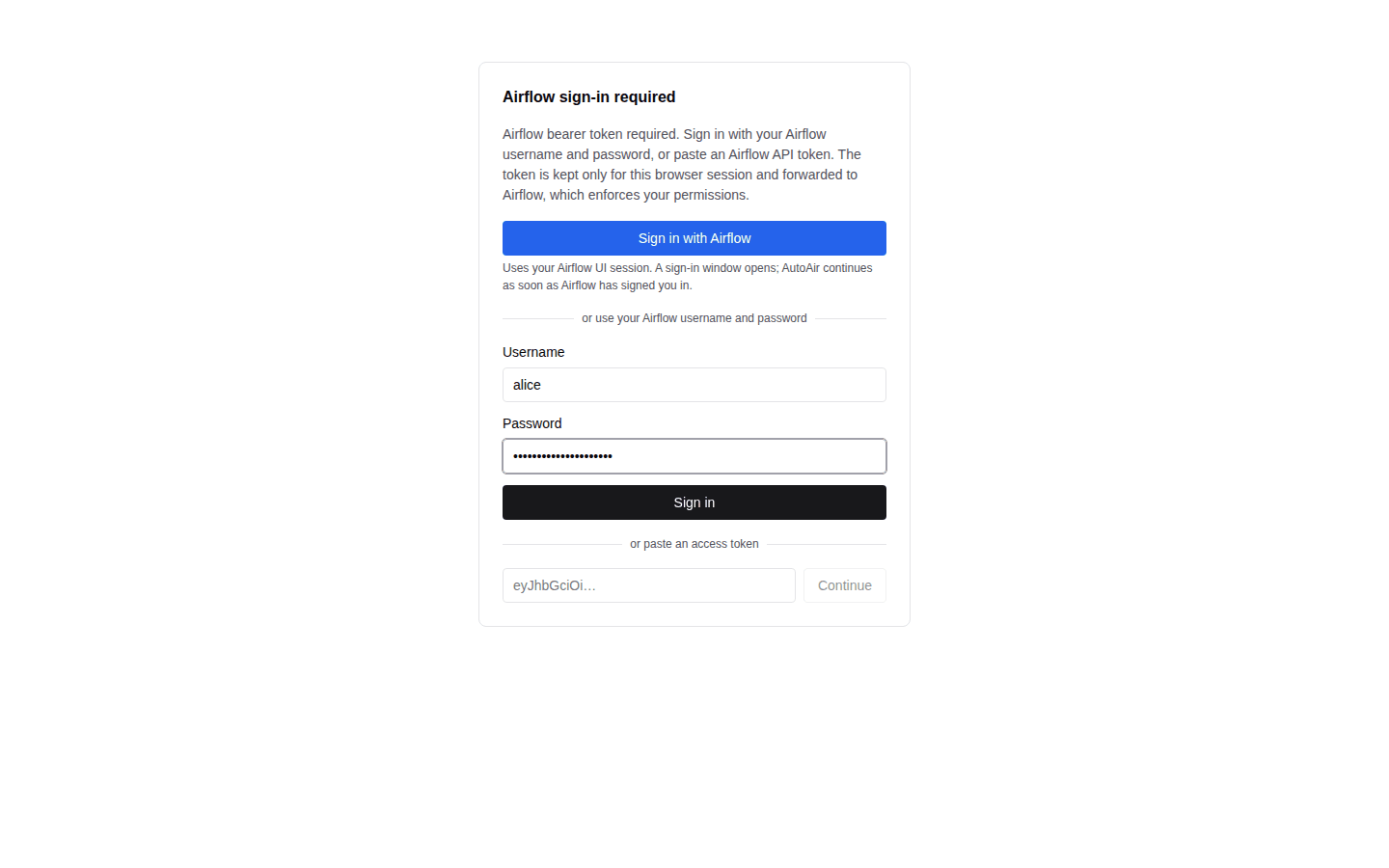
Sign in with Airflow
Sign in with Airflow (GET /api/auth/sso/login) opens Airflow's login page in a small window. When AutoAir is reachable under Airflow's host (server.public_url on the same host and port as sso.airflow_public_url, under its base path), the window returns to AutoAir through Airflow's next=. Otherwise the user signs in to Airflow and the AutoAir tab picks the session up as soon as the cookie is visible to it (it polls GET /api/auth/session). If the browser blocks the window, the panel says so: allow pop-ups, or open Airflow in another tab and sign in there.
Username and password (standalone)
POST /api/auth/login takes {"username": "...", "password": "..."} and returns {"access_token", "token_type": "bearer", "user", "expires_at"}.
- AutoAir forwards the credentials once to
POST {airflow_url}/auth/token(SimpleAuthManager, FAB and Keycloak all serve it) and returns Airflow's JWT. The browser keeps it insessionStorageof that tab, exactly like a pasted token. - The password is never stored or logged (
SecretStr, no request logging), and the response hasCache-Control: no-store. - Airflow's token call times out after
iam.login_timeoutseconds (10). - Disable the form with
AUTOAIR_IAM__LOGIN_ENABLED=false; the route then answers404. In plugin mode the route does not exist: Airflow's own login is used.
Pasting a token
Any Airflow access token works, for example one obtained with POST {airflow}/auth/token. It is kept in sessionStorage of the tab and sent as Authorization: Bearer. API clients and scripts use the same header.
Login rate limiting
Failed password sign-ins (Airflow answers 400, 401 or 403) are counted per client IP and per username (the username is hashed):
- After
AUTOAIR_IAM__LOGIN_MAX_FAILURES(5) failures withinAUTOAIR_IAM__LOGIN_WINDOW_SECONDS(300), further attempts get 429 withRetry-After, and Airflow is not asked. The panel shows "Too many failed attempts. Try again in N s." - Each attempt is reserved before Airflow is asked, so concurrent requests cannot exceed the limit. The reservation is refunded when the sign-in succeeds or Airflow cannot be reached. A successful sign-in clears the username's counter.
- At most
AUTOAIR_IAM__LOGIN_MAX_TRACKED_KEYS(10000) IPs and usernames are tracked; the least recently used are forgotten first. - Where the counters live: with the file backend they are in memory, per process, so N replicas allow N times the limit; put a shared rate limiter in front of several replicas. With a SQL backend and
database.shared_rate_limit=true(the default), failures are counted in thelogin_failurestable and the limit holds across all replicas. See Scaling. - Behind a reverse proxy, the client IP is only the real one when the proxy is trusted: set
server.forwarded_allow_ips(see TLS and HTTP headers). Otherwise every user shares the proxy's IP counter.
This limit is separate from the per-user API rate limits (limits.*), which apply after sign-in.
Sessions
Verification
- Plugin: Airflow's
get_uservalidates the cookie or bearer token on every request. - Standalone: a cookie or bearer token is accepted only after Airflow answers
GET /api/v2/dags?limit=1with it.expis checked locally first; verified tokens are cached for at mostAUTOAIR_AUTH_CACHE_TTLseconds (60) and never pastexp. Signing out through AutoAir drops the cache entry at once. - Audience: Airflow's JWT carries Airflow's audience (
[api_auth] jwt_audience). AutoAir is a relying party that forwards the token to the same Airflow; it neither re-scopes nor re-signs tokens.
Refresh and expiry
The UI runs a session watcher. It:
- refreshes cookie sessions
sso.refresh_margin_seconds(300) beforeexpthroughPOST /api/auth/refresh; - warns before a bearer token (password or pasted) expires, since those cannot be refreshed without the password;
- re-checks the session every
sso.session_check_seconds(60) and when the tab becomes visible, so a sign-out in Airflow signs AutoAir out too (0: check only on API errors).
When the session ends, the sign-in panel opens over the builder. Nothing is lost: the canvas stays, and drafts are kept locally anyway.
Airflow's [api_auth] jwt_expiration_time (default 24 hours) bounds every session. Without an auth manager that refreshes (SimpleAuthManager never does), users sign in again when it ends.
Sign-out
Sign out in the user menu (shown when password sign-in is enabled or the session is a bearer token) calls POST /api/auth/logout. It drops the token from AutoAir's verification cache and asks Airflow to revoke it (GET /api/v2/auth/logout, Airflow 3.2 and later). The response reports revoked, which is true only when Airflow answered 2xx (a redirect to a login page is not a revocation). With a cookie session and sso.propagate_logout=true, the shared cookie is cleared too, which also signs the Airflow UI out. With propagate_logout=false, AutoAir signs out locally and leaves Airflow's session alone.
Logout propagation is best effort: revocation needs Airflow 3.2 or later, and on another replica a verified token may stay trusted until its cache entry expires (at most auth_cache_ttl).
Endpoints
All are under /api/auth in standalone mode.
| Route | Auth | Purpose |
|---|---|---|
GET /api/auth/config | public | What the sign-in page offers: password form, SSO, branding (ui.*) |
GET /api/auth/session | public (verifies what it gets) | The current session: source (cookie/bearer), user, expires_in, refreshable; 401 when there is none. This is how an Airflow sign-out reaches AutoAir |
POST /api/auth/refresh | cookie | Renews a cookie session through Airflow; 409 for bearer tokens, 401 (cookie cleared) when Airflow ended the session |
GET /api/auth/sso/login?next=/ui/... | public | Redirect (307) to Airflow's login, with a return URL only when Airflow will accept it; next must be a same-site path. 404 when sso.enabled=false |
POST /api/auth/login | public, rate-limited | Password sign-in |
POST /api/auth/logout | token or cookie | Revokes the token at Airflow; clears the cookie session |
Cookies
AutoAir reads Airflow's session cookie and, in two cases, sets it: when it relays a refreshed cookie, and when it deletes the cookie on logout. Cookies AutoAir sets are:
HttpOnly;SameSite=server.cookie_samesite(laxby default, orstrict);Secureaccording toserver.cookie_secure:auto(default) when the request came over HTTPS,always, ornever. Behind a TLS-terminating proxy,autoonly works when the proxy is trusted forX-Forwarded-Proto(server.proxy_headersandserver.forwarded_allow_ips).
The token never reaches JavaScript. AutoAir does not copy the cookie into sessionStorage; the browser keeps sending the HttpOnly cookie, and AutoAir forwards it to Airflow as Authorization: Bearer. Pasted and password tokens live in sessionStorage of one tab.
Sharing the cookie across sub-domains
A standalone AutoAir on a sibling sub-domain only receives Airflow's cookie when the proxy in front of Airflow widens it to the parent domain, for example with nginx:
location / {
    proxy_pass http://airflow-api-server:8080;
    proxy_cookie_domain airflow.example.com .example.com;
}
Traefik and Envoy have equivalent cookie rewrites. Widening Airflow's cookie sends the Airflow session to every sub-domain of example.com: only do it when all of them are trusted. Running AutoAir under Airflow's host (another port, or a path behind the same proxy) avoids the rewrite.
CSRF protection
A cookie is sent automatically by the browser, so in standalone mode every state-changing request (POST, PUT, PATCH, DELETE) authenticated by the cookie must:
- carry the
X-AutoAir-CSRFheader, which a foreign page cannot send without a CORS preflight that AutoAir refuses; and - when the browser sends
Origin, come from the same origin or from an origin incors_origins.
Otherwise the request is refused with 403. SameSite=Lax alone is not enough: other ports of the same host and sibling sites of the registrable domain are same-site. Bearer-token requests are exempt (browsers never attach them on their own). The rule is controlled by sso.require_csrf_header (default true). Plugin mode keeps Airflow's model: Airflow's own API relies on SameSite=Lax.
Open redirects
/api/auth/sso/login only accepts same-site paths as next (no scheme, no //host, no backslashes) and only forwards a return URL that Airflow itself would accept.
Settings
| Setting | Default | Description |
|---|---|---|
sso.enabled | true | Standalone: accept the Airflow cookie and offer "Sign in with Airflow" (plugin mode always uses Airflow's session; autoair local turns it off) |
sso.cookie_name | _token | Airflow's session cookie |
sso.airflow_public_url | airflow_url | Airflow as browsers reach it; "Sign in with Airflow" opens <airflow_public_url>/auth/login |
sso.require_csrf_header | true | The CSRF rule above |
sso.refresh_margin_seconds | 300 | Refresh or warn this long before exp |
sso.session_check_seconds | 60 | Periodic session check (0: only on API errors) |
sso.propagate_logout | true | AutoAir logout revokes and clears the Airflow session |
server.public_url | unset | AutoAir's public URL (SSO return URL, links in commits) |
server.cookie_secure, server.cookie_samesite | auto, lax | Attributes of cookies AutoAir sets |
iam.login_enabled | true | Standalone password sign-in |
iam.login_max_failures, iam.login_window_seconds, iam.login_max_tracked_keys, iam.login_timeout | 5, 300, 10000, 10 | Sign-in rate limit and Airflow token-call timeout |
auth_cache_ttl, auth_timeout | 60, 10 | Standalone: verified-token cache and the verification call timeout |
database.shared_rate_limit | true | SQL backends: one sign-in limit for all replicas |
Environment variables follow the usual pattern: AUTOAIR_SSO__ENABLED, AUTOAIR_IAM__LOGIN_ENABLED, AUTOAIR_SERVER__COOKIE_SECURE.
Example: standalone AutoAir next to Airflow behind one proxy
# Airflow at https://data.example.com/, AutoAir at https://data.example.com/autoair/
AUTOAIR_AIRFLOW_URL=http://airflow-api-server:8080          # internal, for API calls
AUTOAIR_SSO__AIRFLOW_PUBLIC_URL=https://data.example.com     # as browsers reach it
AUTOAIR_SERVER__PUBLIC_URL=https://data.example.com/autoair
AUTOAIR_SERVER__FORWARDED_ALLOW_IPS='["10.0.0.10"]'          # the proxy
AUTOAIR_SERVER__COOKIE_SECURE=always
Airflow's [api] base_url path must cover /autoair for the cookie to be sent there; with Airflow at the root path (/) it is.
Troubleshooting
| Symptom | Cause and fix |
|---|---|
| Users must sign in even though they are signed in to Airflow | AutoAir is not on Airflow's host, or not under the cookie's path. Use the same host (another port or a path), or widen the cookie at the proxy |
| "Sign in with Airflow" opens Airflow but never returns | server.public_url is not on Airflow's host and port, so Airflow refuses the return URL. Sign in in the window; the AutoAir tab picks the session up by polling |
403 on every save with a cookie session | The X-AutoAir-CSRF header is stripped by a proxy, or the Origin is not same-origin and not in cors_origins |
429 for everyone after a few failures | The proxy is not trusted, so all users share its IP. Set server.forwarded_allow_ips |
| Session ends after 24 hours despite activity | The auth manager does not refresh tokens (SimpleAuthManager). Raise Airflow's jwt_expiration_time, or use an auth manager with refresh |
| Sign-out in AutoAir does not sign out of Airflow | Airflow is older than 3.2 (no revocation), or sso.propagate_logout=false |