Publishing a marketplace
A marketplace is a signed index.json that lists DAG templates, fragments and extension packages, plus the template files it points to. Platform teams publish one; AutoAir instances pin its public key in AUTOAIR_MARKETPLACE_SOURCES and show its entries in the Templates dialog. Publishing one is covered here; using a marketplace as an author is in Marketplace.
Trust model:
- The index is signed with Ed25519 over its canonical JSON (keys sorted, no whitespace,
signatureremoved). - Every template payload is listed with its SHA-256; a payload that does not match is refused.
- Nothing executes.
dagandfragmententries are data that install into the template gallery.extensionentries describe pip packages and only display their install command; AutoAir never installs Python code at runtime.
Layout
The repository's examples/marketplace/ shows the source layout:
market/
├── templates/
│   ├── daily-http-ingest.json     # kind "dag"
│   └── slack-on-failure.json      # kind "fragment"
├── extensions.json                # optional: pip packages
└── index.json                     # written by `autoair marketplace build`
Template files
Each templates/*.json file is one template in the format the template gallery saves (TemplateInput), plus optional publishing metadata:
| Field | Required | Meaning |
|---|---|---|
id | yes | ^[a-z0-9][a-z0-9_-]{0,80}$; also the template id after installation |
title | yes | 1 to 120 characters |
kind | yes | dag (with spec) or fragment (with fragment). Operator templates are not accepted by the marketplace |
spec | for dag | A complete DagSpec |
fragment | for fragment | {"nodes": [...], "edges": [...]} with at least one node |
description, category, tags | no | Shown in the gallery |
version | no | Shown in the listing (default 1.0.0) |
author, min_airflow | no | Shown in the listing |
requires | no | Provider packages the template needs, for example ["apache-airflow-providers-slack"] |
A fragment from the example:
{
  "id": "slack-on-failure",
  "title": "Slack alert on failure",
  "description": "A final task that runs only when something upstream failed and posts to Slack.",
  "category": "alerts",
  "tags": ["slack", "alerting"],
  "kind": "fragment",
  "version": "1.0.0",
  "author": "AutoAir examples",
  "requires": ["apache-airflow-providers-slack"],
  "fragment": {
    "nodes": [
      {
        "kind": "python_task",
        "id": "alert",
        "task_id": "alert_on_failure",
        "function_name": "alert_on_failure",
        "trigger_rule": "one_failed",
        "code": "from airflow.sdk import get_current_context\n\nctx = get_current_context()\nprint(f\"DAG {ctx['dag'].dag_id} failed in run {ctx['run_id']}\")"
      }
    ]
  }
}
The quickest way to author a template is to build it in AutoAir, save it with Save as template… or Save selection as fragment…, and copy the stored JSON.
Extension entries
extensions.json is a list of pip packages (node kinds, catalog sources, operator libraries):
[
  {
    "id": "autoair-dbt-nodes",
    "title": "dbt node kinds",
    "description": "Node kinds and catalog source for dbt (installed with pip).",
    "category": "extensions",
    "package": "autoair-dbt-nodes",
    "homepage": "https://example.com/autoair-dbt-nodes"
  }
]
package is the pip requirement shown to users; an administrator installs it in the image.
Publish
-
Create a signing key (once). The private key is written with mode
0600; the command prints the base64 public key:autoair marketplace keygen --out market.pem# +oRcDnGQmFi9tgI6BeJDp536UkDFKL/MFKdDGUzN+Ls=Keep
market.pemin your secret store (for example a CI secret). Anyone holding it can publish templates your users will trust. -
Build and sign the index:
autoair marketplace build ./market --name acme --key market.pem \--description "ACME data platform templates"# 3 entries → market/index.jsonbuildvalidates every template against the template model (an invalid file fails the build), computes SHA-256 hashes of the exact file bytes and signs the index. Without--keythe index is unsigned. -
Verify before uploading:
autoair marketplace verify ./market/index.json --public-key '+oRcDnGQmFi9tgI6BeJDp536UkDFKL/MFKdDGUzN+Ls='# signature OK -
Upload the whole folder (index and
templates/) to any location AutoAir can read: an HTTPS server, a bucket (s3://,gs://), or a shared path (file://). Payload paths are resolved relative to the index URL.
The keygen and build commands refuse to run when features.marketplace is off in the environment where you run them.
Publishing from CI
# .github/workflows/marketplace.yml (excerpt)
- run: pip install autoair
- run: printf '%s' "$MARKET_KEY" > market.pem
  env: { MARKET_KEY: "${{ secrets.MARKET_KEY }}" }
- run: autoair marketplace build ./market --name acme --key market.pem
- run: autoair marketplace verify ./market/index.json --public-key "${{ vars.MARKET_PUBLIC_KEY }}"
- run: aws s3 sync ./market s3://acme-autoair-market/ --delete
Rebuild and re-sign whenever a template changes: editing a template file without rebuilding makes its hash mismatch, and installs of that entry are refused.
Index format
index.json (format 1), as written by build for the example folder:
{
  "format": 1,
  "name": "acme",
  "description": "ACME data platform templates",
  "entries": [
    {
      "id": "daily-http-ingest",
      "kind": "dag",
      "title": "Daily HTTP ingest",
      "description": "Fetch a JSON API every day, transform it in Python and log the row count.",
      "category": "ingestion",
      "tags": ["http", "daily"],
      "version": "1.1.0",
      "author": "AutoAir examples",
      "requires": [],
      "path": "templates/daily-http-ingest.json",
      "sha256": "1412916abbff44d75e14a63202ef5671b5d513ff0eab9dcd67511b3d30fde6db"
    },
    {
      "id": "autoair-dbt-nodes",
      "kind": "extension",
      "title": "dbt node kinds",
      "category": "extensions",
      "package": "autoair-dbt-nodes",
      "homepage": "https://example.com/autoair-dbt-nodes"
    }
  ],
  "signature": "VDcJsaSce0fshmMYx5TNGUOm...NAw=="
}
| Entry field | Meaning |
|---|---|
id, kind, title, description, category, tags, version, author, min_airflow, requires | Listing metadata |
path | Payload path relative to the index; absolute paths, URLs and .. are rejected |
sha256 | Hash of the payload bytes |
package, homepage | extension entries only |
Connect AutoAir to the marketplace
AUTOAIR_MARKETPLACE_SOURCES='[
  {"name": "acme", "url": "https://dags.acme.io/market/index.json",
   "public_key": "+oRcDnGQmFi9tgI6BeJDp536UkDFKL/MFKdDGUzN+Ls="}
]'
| Source field | Default | Meaning |
|---|---|---|
name | required | ^[A-Za-z0-9_.-]{1,64}$; installed templates are tagged marketplace:<name> |
url | required | https://, file://, s3://, gs:// or any fsspec URL of index.json |
public_key | none | Base64 raw Ed25519 public key the index must be signed with |
require_signature | true | false accepts an unsigned internal index; it is shown as UNSIGNED |
| Setting | Default | |
|---|---|---|
marketplace_timeout | 15 | Seconds per index or payload download |
marketplace_cache_ttl | 300 | Seconds a fetched index is reused (per replica) |
marketplace_max_bytes | 5242880 | Largest index or payload accepted |
features.marketplace | true | Switch the feature off entirely |
HTTPS downloads use the marketplace outbound client (AUTOAIR_OUTBOUND__CLIENTS), so a private CA or proxy can be set for it alone.
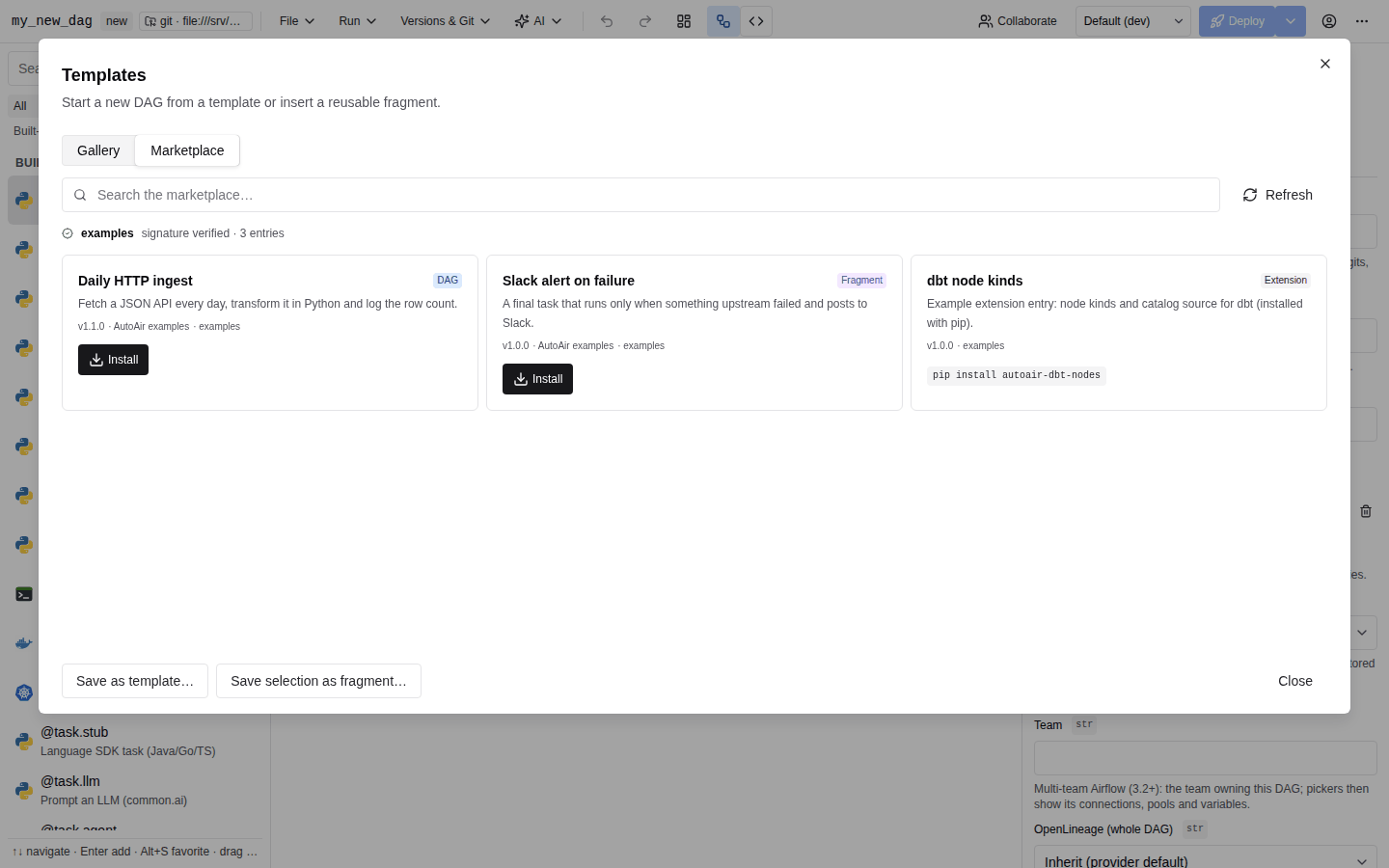
Users with the template:write permission install entries; the API is GET /api/marketplace (listing, ?refresh=true bypasses the cache) and POST /api/marketplace/install with {"source": "acme", "entry_id": "daily-http-ingest"}.
Failure behaviour
| Situation | Result |
|---|---|
| Index unreachable or not JSON | The source is listed with ok: false and the error; other sources still work |
Signature missing or invalid (with require_signature) | The whole source is rejected: index signature is missing or invalid |
| Payload hash differs from the index | Install refused: payload hash mismatch |
| Payload id or kind differs from its index entry | Install refused |
| Payload is not a valid template | Install refused with the validation error |
| Entry is an extension | Install refused with the pip install <package> hint |
Index or payload larger than marketplace_max_bytes | Refused |
Key rotation
Generate a new key, rebuild and re-sign the index, then update public_key in every AutoAir instance. Between the upload and the configuration change, instances with the old key reject the source (it fails closed). To avoid the gap, publish the newly signed index under a new URL and configure it as a second source before retiring the old one.